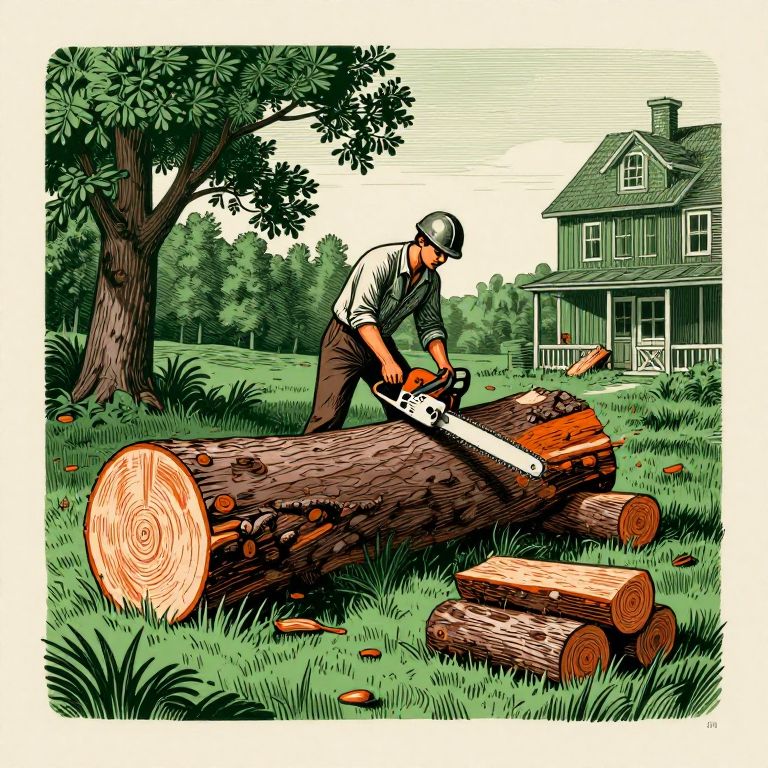
 Cost guide · Updated July 2026
 Fallen Tree Removal Cost
Fallen tree removal cost by situation
| Situation | Typical cost |
|---|---|
| Small tree / large limb on open ground | $75 – $200 |
| Medium tree on open ground, cut + haul | $150 – $400 |
| Large trunk, equipment needed to move sections | $400 – $1,000 |
| Tree under tension (leaning on another tree/fence) | $400 – $1,000 |
| Tree on house, garage, or vehicle | $1,500 – $3,000+ (emergency) |
What you're actually paying for
- Bucking: cutting the trunk into movable sections — fast on open ground.
- Hauling and disposal: often half the bill; keeping the wood as firewood cuts it substantially.
- Equipment: trunks over ~20 inches need a grapple truck or skid steer to move — that's the jump to the $400–$800 tier.
- Stump: an uprooted root ball costs $150–$400 extra to cut free and haul; a snapped trunk leaves a normal stump to grind.
The tension warning (read this before touching a chainsaw)
A fallen tree resting on anything — another tree, a fence, a shed, its own sprung branches — is storing energy like a loaded spring. Cutting the wrong side releases it instantly: trunks whip sideways, root balls slam upright, and "barber chair" splits launch wood upward. This is how experienced chainsaw users get killed. Open ground, small diameter, no tension: reasonable DIY. Anything else: hire it out.
Fallen tree FAQ
How much does it cost to remove a fallen tree?
Removing a tree that's already on the ground costs $100–$600 for most homeowners in 2026 — a fraction of standing-tree prices, because the dangerous work (getting it down) is already done. Simple small trees can run as little as $75–$300; large trunks requiring heavy equipment run $400–$1,000; and a fallen tree resting on a structure is emergency work at $1,500+.
Why is a fallen tree so much cheaper to remove than a standing one?
Standing-tree pricing is mostly risk and rigging: climbing, roping limbs down, controlling the fall. A tree on open ground is just cutting and hauling. The exception is a tree under tension — leaning on another tree or a structure — which is as dangerous as any standing removal.
Who pays when a tree falls across a property line?
In most states, each owner handles the portion on their own property, through their own insurance if a structure was hit. The tree's original owner is generally only liable if they demonstrably knew it was hazardous beforehand.
Can I cut up a fallen tree myself?
Open-ground trunks under about 12 inches in diameter are a reasonable chainsaw job for an experienced homeowner with proper protective equipment. Never cut a tree under tension — trunks resting on structures, fences, or other trees store spring-loaded energy that kills people when released wrong. That's professional work.